
Interview| Ramy Shaath: In France, human rights end where Palestine begins
Paris moves from campaigning for his release to seeking his deportation
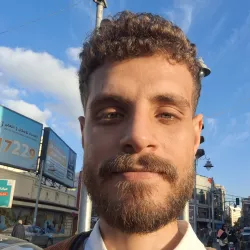
In January 2022, French President Emmanuel Macron welcomed Palestinian-Egyptian activist Ramy Shaath upon his arrival in Paris, framing him as a victim of political persecution. Shaath had spent two and a half years in an Egyptian prison following his arrest in July 2019 following his role in founding the Egyptian chapter of the Boycott, Divestment, Sanctions (BDS) movement. He was released only after reports emerged that he had been forced to renounce his Egyptian citizenship as a condition for leaving prison and reuniting with his French wife.
Three years later, Ramy, the son of the veteran Palestinian politician Nabil Shaath who held several ministerial posts including foreign affairs and information, found himself facing the threat of deportation from France on the grounds that he poses a “threat to public order,” once again because of his activism around the boycott of Israel. Following a hearing before an advisory deportation committee on May 11, his lawyer, Damia Tahraoui, told the press that authorities were legally positioned to issue an immediate deportation order. Less than two weeks later, on May 21, a court in Nanterre ruled against this deportation request.
Speaking to Al Manassa before the Nanterre hearing, Ramy traced a series of escalating pressures that began with a refusal to renew his residency permit and culminated in an official notice of the state’s intent to deport him, all because of his stance against the genocide being inflicted on his people and his opposition to the Zionist project disposessing Palestinians of their land.
A threat to public order
Ramy did not see his predicament as a sudden development. It all began, in his view, with the outbreak of the war on Gaza, when he co-founded the Urgence Palestine movement. The initiative quickly became one of the most prominent faces of pro-Palestine mobilization in France, expanding to 32 local branches across various cities.
As the movement’s public profile grew, Ramy says he became a target. Authorities first attempted to implicate him in a “justification of terrorism” case based on comments he made about Palestinian resistance, though prosecutors ultimately dropped the case.
The pressure then shifted to the administrative sphere: repeated delays and obstacles in renewing his residency permit, the closure of his bank account, the suspension of his health insurance card, and finally a notification from the Nanterre prefecture declaring its intention to deport him and branding him a “threat to public order.”
Ramy describes this as a form of administrative, rather than legal, harassment. He notes that he has filed nine separate lawsuits against the French state over the refusal to renew his residency, none of which has been scheduled for a ruling. Whenever he has sought emergency judicial intervention, courts have rejected his requests on the grounds that there was no urgency.
The message, he says, is straightforward: “Keep quiet, and we’ll renew your residency.”
A dossier steeped in racism
The official justification for why Ramy was considered a threat to public order eventually came in a four-page document issued by Nanterre authorities. He told Al Manassa that the document was not merely a political indictment, but a text infused with “racism toward everything Palestinian and profound ignorance of the Palestinian cause.”
For Ramy, anti-Palestinian racism in France is more prominent at the state level than in civil society. While he has rarely encountered racism on the French streets, he has faced “ten distinct confrontations” engineered by the state and its administrative systems.
This institutional racism, he argues, is also evident in the way French authorities portray pro-Palestine movements and groups. The state casts those participating in authorized, public demonstrations as potential criminals. By extension, anyone who collaborates with these groups or speaks at their rallies is branded a suspect as well. The logic extends far beyond Shaath himself; he says: it encompasses the “hundreds of thousands of French citizens” who have mobilized in solidarity with Palestine.
The four-page dossier meticulously catalogs statements Ramy made during lectures and seminars, including his description of the two-state solution as “a lie and a deception” and his assertion that the only viable solution is “the dismantling of the Zionist project and the establishment of a Palestinian state from the river to the sea.”
Shaath does not attempt to distance himself from these statements. “I said what I said, I stand by it, and I’m determined to keep saying it,” he told Al Manassa. “And whoever doesn’t like it, can bang their head against the wall.”
He insists that these positions, whether one agrees with them or not, constitute legitimate political opinions, not national security threats.
Ramy points to another section of the dossier that monitors his communications with Palestinian cultural institutions and intellectuals around the world. The state claimed that he aimed to form a unified political stance around a single Palestinian state from the river to the sea.
“But what right did the French state have to wiretap my phone in the first place?” he asks, marveling at how conversations with intellectuals could be repackaged as intelligence material for a security report.
The limits of the rule of law in France
Months after arriving in France, Ramy and his wife approached the African Commission on Human and Peoples’ Rights to file a complaint against the Egyptian government for the violations he endured during his detention. These included enforced disappearance, detention without evidence, and the renewal of his pretrial custody in hearings that he and his lawyers were routinely barred from attending.
Reflecting on the experience brings him back to two contrasting moments.
The first was his release from prison in Egypt in early 2022 after more than two and a half years in pretrial detention, following a widespread international campaign demanding his freedom supported by Macron himself. The second is the threat of deportation he faces today.
Through it all, Ramy emphasizes that he remains unchanged: “My positions against tyranny and occupation are exactly the same.”
What changed, he argues, is France itself. When he emerged from Egyptian prisons, France wanted to pose as a “defender of human rights, championing an activist who faced persecution in Egypt without a clear legal process.” When Macron first welcomed him as a victim of political persecution, “France wanted the photo-op,” he says.
Yet when it comes to Palestine, human rights become secondary.
“In France, as in many Western nations, they have no problem with you criticizing the Egyptian regime or other governments,” he explains. “But the moment you approach the Zionist colonial project in Palestine, or challenge their interests in the ongoing genocide of the Palestinian people and the expansion into their land, that is when the rule of law in France collapses. That is where all claims to human rights, freedom of expression, freedom of assembly, and the right to protest completely dissolve.”
“Stay silent, or face Ramy’s fate”
Ramy does not believe that the French authorities’ ultimate goal is to actually deport him. Rather, he suspects they aim to issue a deportation order, then use the practical impossibility of carrying it out as justification for keeping him in France “without rights or residency.” He would be left unable to work, denied healthcare or legal protections, and potentially even placed under house arrest.
He characterizes this as an attempt to exclude him from the law’s protection through administrative means. The objective, he argues, is twofold: to silence his voice and to send a chilling message to the broader pro-Palestine movement in France.
“Be silent,” it says, “or face Ramy’s fate.”
In practice, Ramy’s potential deportation faces an obvious obstacle: there is nowhere to deport him. He is no longer an Egyptian citizen, and Palestine itself remains a war zone.
Meanwhile, the legal process remains suspended between administrative and judicial channels. A mere “notice of intent to deport,” Ramy notes, does not yet grant him the grounds to appeal the measure before a judge, though he tells Al Manassa that he will pursue legal action immediately if a final order is issued.
Until then, he draws strength from the support and solidarity he has received within France. Dozens of French lawmakers, “potentially more than a hundred”, have publicly condemned the measures deployed against him. To Ramy, this backlash reflects a growing internal awareness that France is “sliding rapidly” into an authoritarianism designed purely to shield Israel from criticism and accountability.
On May 21, dozens of demonstrators gathered outside the judicial court in Nanterre in solidarity while Ramy attended his hearing before the French advisory committee on foreign deportations.
Ramy emerged from the hearing triumphant, wearing his Palestinian keffiyeh. Speaking to the French press, he said the committee concluded he had “never posed a threat,” describing their rejection of the administrative authority’s deportation request as a powerful “symbolic” victory.
During the hearing, authorities cited his ties to several French organizations advocating for Palestinian rights, including Urgence Palestine, as well as statements he had made at public demonstrations. His lawyer, Nicolas de Sa-Palliax, countered that authorities were attempting to achieve through administrative procedures what they had failed to through the courts.
For Ramy, the hearing was not a trial of his character, nor was it a “trial of Palestine.” Instead, it became a “trial of Zionism, of genocide, and of French complicity in that genocide.”
“This battle is not about me,” he stresses. “This battle is about the Palestinian narrative. It is about the right of the French public to listen, to debate, to form an opinion, to express themselves, to protest, and to defend Palestinian rights.”
As the conversation draws to a close, Shaath insists that his true rights” cannot be reduced to a residency permit or his own legal status.
“My real right,” he says, “is ending the genocide in Palestine, the freedom of Palestine, holding accountable everyone who justified this genocide or supplied it with weapons, and guaranteeing people in France and elsewhere the freedom to express their support for Palestine without fear.”
(*) A version of this article first appeared in Arabic on May 25, 2026.